
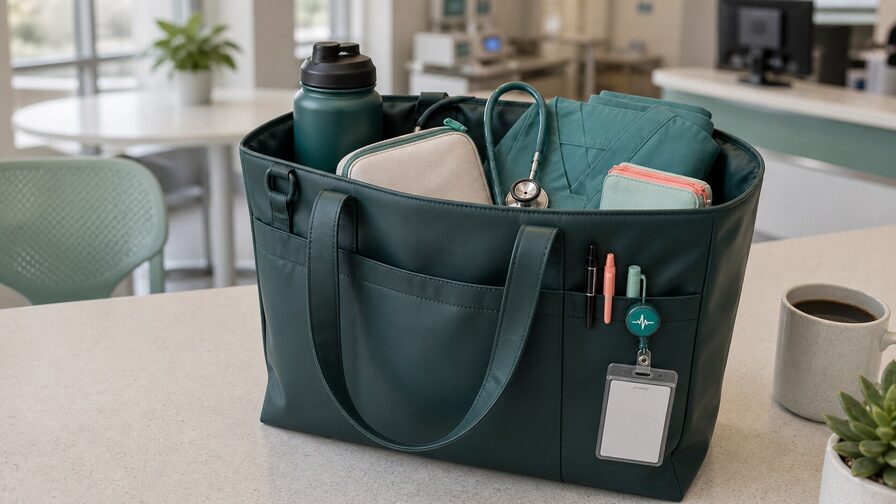
Twelve hours in, your bag has been dropped on a supply room floor, wiped down between patients, and dug through one-handed while you charted with the other. Most bags are not built for that. A "best nursing bags" search turns up a lot of totes that look great in a product photo and fall apart against a med cart by week three, so this guide skips the styling talk and starts with what actually has to hold up on a unit.
What actually makes a nursing bag work-ready
Before comparing totes and backpacks, run any nursing bag against the same short list. These are the features that separate one that survives a year of 12-hour shifts from one that needs replacing by spring.
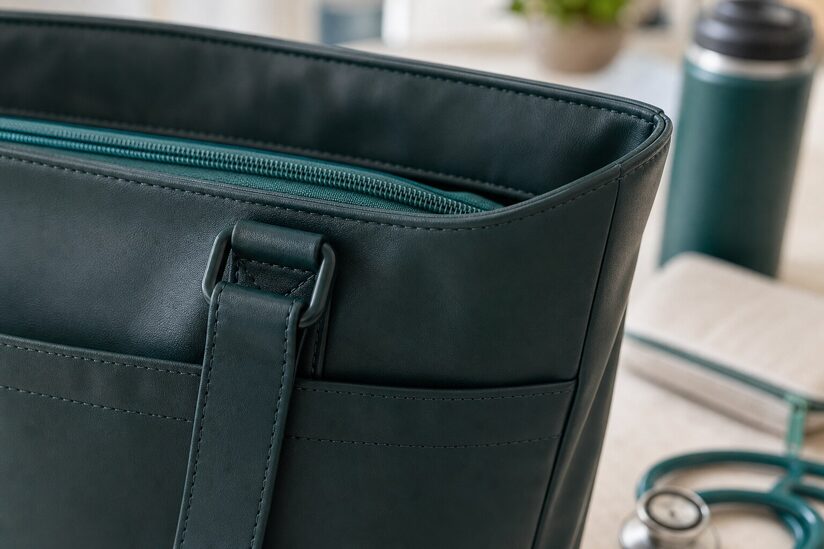
- A wipeable exterior. Coated canvas, ballistic nylon, or treated polyester. If it needs a fabric cleaner and a prayer after a spill, it is not a work bag.
- A shape that survives being set on the floor. A structured base or feet keeps the bottom off breakroom floors and supply room carpet.
- At least one dedicated pocket for tools. Somewhere your stethoscope, bandage shears, and a pen do not end up loose at the bottom, tangled with your badge reel.
- Padded, adjustable straps. Anything you carry for 12 hours has to sit right on the shoulder, not just look fine on a hanger.
- Real capacity without being oversized. Big enough for a lunch, a water bottle, and a change of shoes, small enough that it is not another thing to maneuver around a bed rail.
Everything past this checklist, color, brand, whether it has a laptop sleeve, is preference. This part is not.
Tote, backpack, or rolling bag
There is no single right answer for which nursing bag style to buy. Each trades off differently, and the right one depends on how you actually move through a shift.
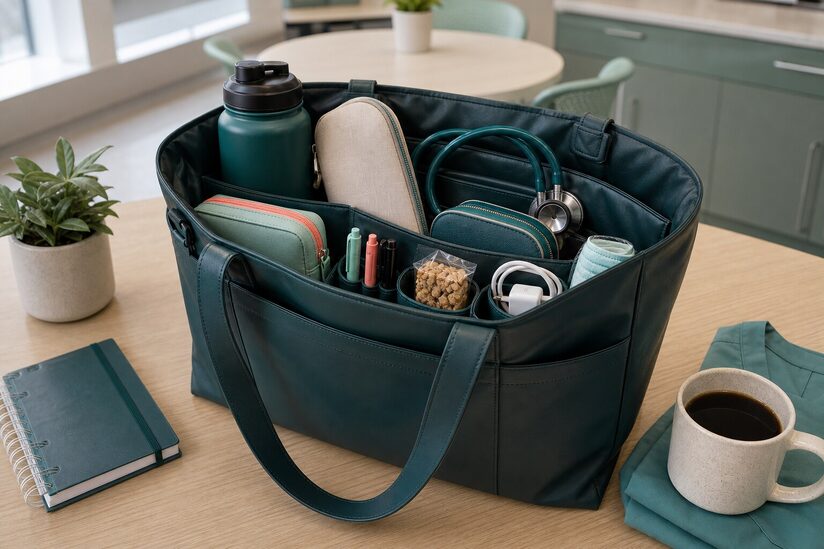
Totes
Open-top access is the whole appeal: you can see and grab everything without unzipping compartment after compartment mid-shift. The tradeoff is less structure and less protection for a laptop or tablet if you carry one. Best for nurses who are in and out of their bag constantly and rarely carry electronics.
Backpacks
Hands-free carry and better weight distribution across both shoulders, which matters over a full shift or a walk through a parking garage at 6 a.m. Compartments keep gear more separated, at the cost of the quick top-down access a tote gives you. Best for nursing students hauling textbooks, and anyone commuting on foot, bike, or public transit.
Rolling bags
Built for volume, not speed. If you are hauling a laptop, a change of scrubs, meal prep for a stretch of shifts, and clinical references, wheels save your shoulder. The tradeoff is size and maneuverability in a cramped nurses' station. Best for clinical rotation days and travel nurses relocating gear between assignments, not for a typical shift bag.
The right bag for your role
Floor and unit nurses
Prioritize quick access and a compact footprint over capacity. A mid-size tote (roughly 15 to 20 liters) usually covers a lunch, a water bottle, a phone charger, and a small tool pocket without becoming bulky at a crowded nurses' station.
Nursing students and new grads
Clinical days mean textbooks, a laptop, a stethoscope, and reference guides on top of the usual essentials, so capacity wins over minimalism here. A structured backpack with a padded laptop sleeve holds up better across a full program than a tote does. If you are close to graduating, pair your bag shopping with our first year nurse survival guide, since what you carry changes fast once orientation ends.
Travel and per diem nurses
This is where most "best nursing bags" roundups stop short, and it is the biggest gap worth filling. If you are moving between contracts, your bag has to do double duty: a daily shift bag and a piece of luggage. A few things matter here that a floor nurse never has to think about:
- Carry-on sizing. If you are flying between assignments, check your bag against your airline's personal-item dimensions before you buy. A bag that is perfect on the unit but too big to gate-check adds friction every relocation.
- A luggage trolley sleeve. A slot that slides over a rolling suitcase handle turns your work bag into a second carry-on for travel days, instead of one more thing to hold.
- Durability over a full assignment, not a full shift. A 13-week contract puts more total wear on a bag than most staff nurses see in a year. Cheap zippers and thin straps show it fast.
- Per diem nurses working multiple facilities benefit from the same tool-pocket organization as everyone else, plus a bag nondescript enough to move between different employers' dress codes without standing out.
If you are weighing a travel contract against a local one and want the fuller picture on what those assignments actually pay once you account for stipends and guaranteed hours, our breakdown of what ICU travel nurses really earn is worth reading before your next contract, not just your next bag.
Brands nurses keep recommending
Across independent nursing bag buying guides, the same handful of names come up again and again, for reasons that hold up against the checklist above rather than just marketing.
- Nurse Mates builds bags specifically for clinical use, with wipeable exteriors and dedicated tool pockets already sized for shears and a stethoscope.
- BÉIS makes structured commuter totes with a padded laptop sleeve and a trolley sleeve, a favorite among travel nurses living partly out of a suitcase.
- CALPAK is known for durable totes that hold their shape shift after shift instead of slumping by month two.
- Dagne Dover uses neoprene construction with color-coded interior organization, popular with new grads building a first work bag from scratch.
- Bogg Bag leans fully into sanitation: molded, hose-it-down construction over polish.
- Carhartt brings workwear-grade durability, reinforced stitching and water-repellent fabric built to survive daily abuse over looking sleek.
None of these is universally "the best." Match the brand's strength to the checklist item you personally care about most, not the other way around.
Keep it clean between shifts
A bag that touches nurses' stations, breakroom counters, and the floor all day is a surface like any other. The CDC's guidance on environmental cleaning in healthcare settings is written for the unit, not your tote, but the same logic applies to anything that travels between patient care areas with you. A few habits keep it from becoming the thing you forget to disinfect.
- Wipe down the exterior with a disinfectant wipe at the end of each shift, the same way you would a phone or a badge reel.
- Empty it weekly. Crumbs, spilled hand sanitizer, and old snack wrappers build up fast in a bag that goes everywhere with you.
- Keep a spare tote or backpack in rotation so one is always drying out or airing between deep cleans.
- Machine-wash what the label allows, roughly once a month for fabric bags in regular clinical use.
Is a nicer nursing bag actually worth it
Run the simple math before deciding. Working three 12-hour shifts a week comes out to roughly 150 shifts a year. A $40 bag that survives one full year before the zipper fails costs about 27 cents a shift. A $150 bag that holds up for five years averages closer to 20 cents a shift, and you are not mid-shift with a broken strap or replacing it twice as often. Past a certain price point you are paying for style, not durability, so match the spend to how hard you actually use it rather than the sticker price alone.
Whatever you land on, it is packing for a job worth having. If you are weighing your next move, browse open travel nursing contracts to see what is paying right now.
FAQ: nursing bags
Tote, backpack, or rolling bag: which should I actually get?
Pick based on how you move, not how it looks. Totes suit nurses who are constantly grabbing items mid-shift. Backpacks suit anyone commuting on foot or carrying a laptop. Rolling bags suit clinical rotation days and travel nurses relocating gear between contracts, not a typical shift.
What should a nursing student pack in their clinical bag?
Cover the basics first: a stethoscope, a penlight, bandage scissors, a small notepad, and your clinical reference guides. Add a padded laptop sleeve if your program uses digital charting during clinicals, since that is the item most likely to get crushed in an unstructured tote.
How do I clean a fabric nursing bag between shifts?
Wipe the exterior daily with a disinfectant wipe, empty the contents weekly, and machine-wash on a gentle cycle when the care label allows it, roughly monthly for a bag in daily clinical use. Bags with a coated or treated exterior hold up to this far longer than untreated canvas.
Is a rolling bag practical on the unit?
Not for a typical shift. Most nurses' stations and hallways are too tight for one day to day. Rolling bags earn their space for clinical days with textbooks and equipment, or for travel nurses moving belongings between assignments, not as a daily work bag.
What size nursing bag do I actually need?
For a standard shift, 15 to 20 liters covers a lunch, a water bottle, a charger, and a tool pocket without becoming bulky. Nursing students and anyone carrying a laptop and references should look closer to 20 to 30 liters.
NurseRoam Admin
Writes for NurseRoam on pay transparency, travel contracts, and the moves that build a clinical career. Every guide is grounded in real, posted rates.